
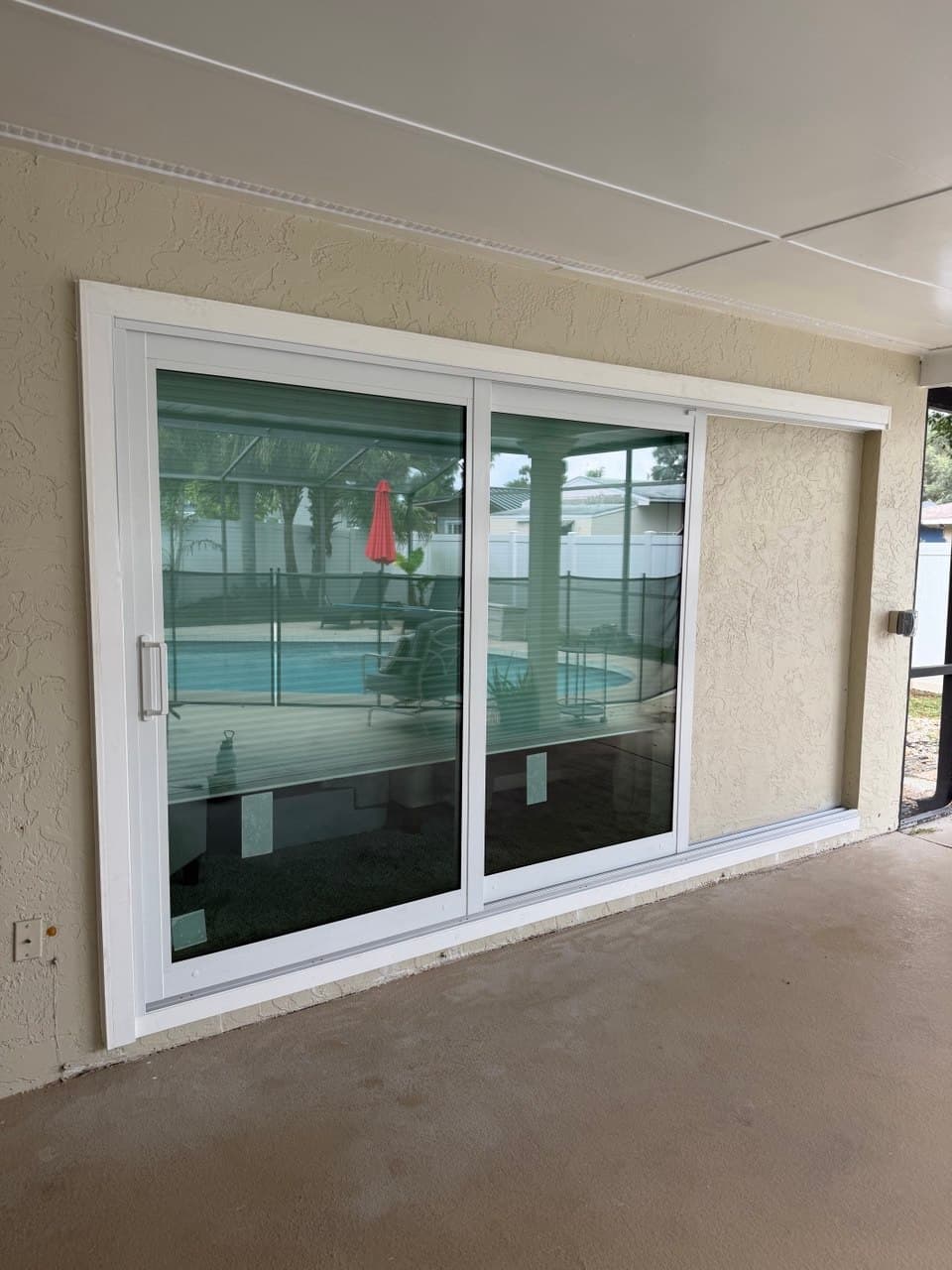
Why vinyl became the default frame for a slider
Walk into most window and door showrooms and ask about a sliding patio door, and the frame you're shown first will almost always be vinyl. That's not an accident of marketing, it's because vinyl solved several problems for sliding doors specifically better than the alternatives it displaced. It doesn't need painting, it doesn't rot, it doesn't conduct heat and cold the way a metal frame does, and it extrudes into consistent multi-chamber profiles cheaply enough that a wide slider frame can be built without the cost climbing the way it would in wood or fiberglass. For a component that's mostly frame and glass, where the frame's job is mechanical as much as decorative, vinyl turned out to be the material best suited to the job rather than just the cheapest one.
Reinforcement on a wide span
Vinyl by itself is not particularly stiff, which is fine on a narrow window sash and a real problem on a slider that might span six, eight, or more feet with a heavy glass panel hanging in a fixed section or rolling along the bottom. Manufacturers address this by reinforcing the frame, typically with steel or aluminum inserts run through the internal chambers of the vinyl extrusion at the header and the sides, sometimes the sill too on wider units. That reinforcement is invisible once the door is installed and it's the difference between a frame that stays straight under the weight of a wide fixed panel and one that bows over time, which then throws off how the operating panel rides in the track. On a genuinely wide multi-panel slider, ask what's reinforcing the frame. It's not a question every salesperson expects, and the answer tells you a lot about the unit's quality.
Hardware you can still get parts for, years later
This is the practical argument for vinyl that doesn't get talked about enough. Because vinyl sliders are the dominant configuration in the residential market and have been for decades, the rollers, tracks, locks, and handles used across most vinyl slider lines are common enough that replacement parts are genuinely available years, sometimes a decade or more, after the original install. That matters, because a slider is a mechanical door with wearing parts, not a static panel, and our post on why sliding doors stop gliding covers just how often the fix for a dragging or jumping slider is hardware, not the whole unit. A door built around widely available, standard hardware is a door you can keep servicing rather than one that becomes a special-order problem the first time a roller wears out.
Thermal performance against an aluminum slider
Aluminum was the standard slider frame material for decades before vinyl took over, and it still shows up, especially in older homes and in some contemporary or commercial-influenced designs where a very slim sightline is the priority. The tradeoff is thermal. Aluminum conducts heat and cold efficiently, which is exactly what you don't want in a frame that spans the width of a wall opening. Even with a thermal break, a strip of less conductive material interrupting the metal, an aluminum slider frame transfers more heat and cold than a multi-chamber vinyl frame does, and on a Pennsylvania winter day that shows up as a cold frame perimeter and, eventually, condensation right at the frame edge. Vinyl's hollow multi-chamber construction traps air within the frame itself, which acts as its own insulation layer the way aluminum, thermally broken or not, can't match. If frame slimness is the deciding factor for a specific design, aluminum still has a place. For most residential patio door openings, vinyl outperforms it on comfort for a lower cost.
Color limits and heat on a dark frame
Vinyl's one real limitation is color. Unlike a painted material, a standard vinyl frame's color runs through the material rather than sitting on top of it, and dark colors, especially black and dark bronze, absorb enough solar heat to distort or warp a standard vinyl profile over repeated hot summers, particularly on a south-facing exposure. This is the same physical issue that makes dark vinyl siding a bad idea on a sun- facing wall, and it's real, not overcautious marketing. Manufacturers who offer dark vinyl colors on doors and windows generally do it through a laminate or capstock layer, a heat-resistant colored film or coating bonded to the base profile, engineered specifically to handle that solar load without the substrate warping underneath it. If you want a dark frame on a sliding door with real sun exposure, confirm it's built with that kind of heat-managed exterior layer rather than solid-color vinyl straight through, because that detail is what determines whether the frame holds its shape after a few Pennsylvania summers.
What separates a good vinyl slider from a cheap one
Vinyl sliders vary enormously in quality despite looking similar in a showroom, and the differences are almost all in details you can't see from the outside. Wall thickness of the vinyl extrusion itself is one, a thicker-walled profile resists flexing and impact better than a thin one built to a minimum spec. Welded corners, where the frame members are fusion-welded into permanent, sealed joints, hold up better over time than mechanically fastened corners held together with screws and corner keys, which can work loose and open a path for air and water at exactly the weakest point in the frame. And the steel or aluminum reinforcement covered above either exists at the spans that need it or it doesn't. None of these show up in a brochure photo, which is exactly why the measurement visit and an honest conversation about what's actually in the unit matters more than comparing two doors side by side in a parking lot.
Frequently asked questions
Is vinyl or fiberglass better for a sliding patio door frame?
Vinyl dominates the category for good reason: it's what most slider hardware is designed and manufactured around, which means better long-term parts availability, and it performs well thermally at a lower cost than fiberglass framing. Fiberglass patio door frames exist and perform well too, but they're a smaller share of the market and command a higher price for a similar thermal result.
Will a black vinyl patio door frame warp in the sun?
A standard solid-color vinyl frame can, on a hot, south-facing exposure. Manufacturers who offer dark colors responsibly build them with a heat-resistant capstock or laminate layer engineered for that solar load. Confirm that detail before ordering a dark frame for a sun-exposed opening.
How wide can a vinyl sliding door span before it needs special support?
Most standard vinyl sliders in the six to eight foot range are reinforced as a matter of course. Beyond that, into wider three and four panel configurations, reinforcement and header sizing stop being optional and become the determining factor in whether the frame stays straight. We check what's carrying the load above the opening before quoting a wide unit.
Can the hardware on an old vinyl slider be replaced instead of the whole door?
Very often, yes. Rollers, tracks, locks, and handles on standard vinyl sliders are widely available parts precisely because the configuration has been the market standard for so long. A dragging or jumping door is worth having looked at as a repair before it's treated as a replacement job.