
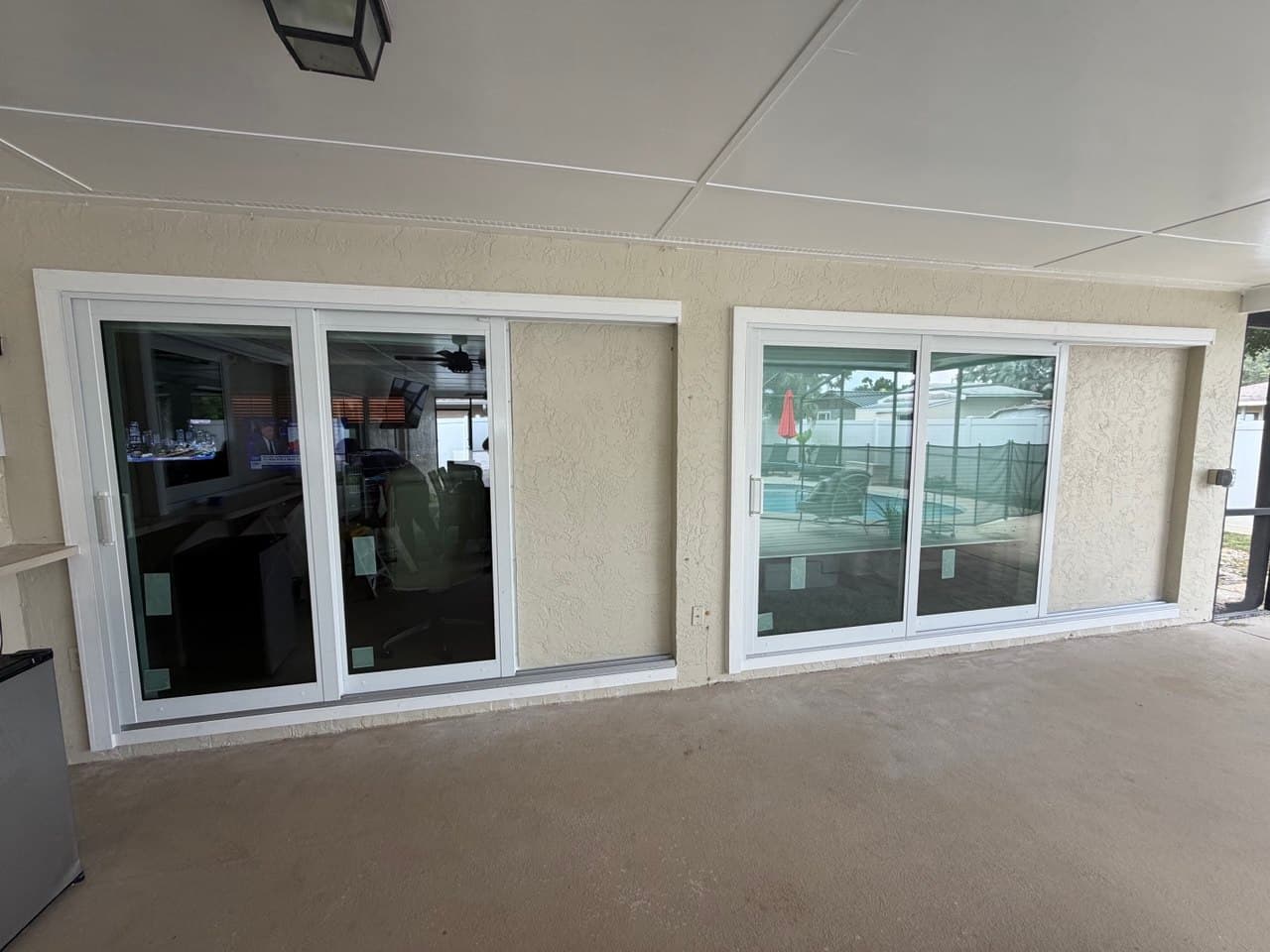
Sliding or hinged, decided before anything else
Patio door is a category, not a style. It covers two mechanically unrelated things: a slider, where one or more panels roll sideways past a fixed panel, and a hinged patio door, which is a wide glazed door that swings. They cost differently, install differently, and fail differently.
A slider takes no floor space to operate, which is the whole argument for it. In a dining room with a table three feet from the wall, or a bedroom opening onto a small deck, nothing else fits. It also gives you the largest glass area for the money, because the frame members are thin and the panels are big. The cost is that the moving panel is heavy, it rides on hardware, and hardware wears.
A hinged patio door, which most people mean when they say French doors, seals better in principle because it closes by compression against a stop rather than by sliding along an interlock. It also gives you a full clear opening rather than half of one. In exchange it needs three or four feet of swing clearance on one side, and hanging it correctly is a fussier job.
The other honest input is what is already there. Swapping a slider for a hinged unit usually means rebuilding the opening, because the rough opening height and the header sizing are not the same. That is a different job than replacing like for like, and it should be priced as one.
Everything important happens in the bottom two inches
A sliding panel is carried entirely by a pair of roller assemblies bolted into its bottom rail. The top track keeps the panel from tipping and carries no weight. So the whole unit, glass and all, is standing on four small wheels. Our post on why sliding doors stop gliding covers what that means once a door is already in service. What matters at replacement time is what you are buying and how it gets set.
Rollers
Cheap sliders use a single roller per corner, usually nylon. Better ones use tandem rollers, two wheels on a pivoting bracket, which spreads the load and keeps the panel rolling when one wheel passes over grit. Steel or steel-on-nylon rides better under weight than plain nylon. Both have an adjustment screw at the bottom edge of the panel, and the ability to reach that screw without disassembling anything is worth checking before you buy.
Track
The track is the wear surface, and it is usually either rolled aluminum as part of the sill extrusion, or a separate stainless or aluminum cap set into it. A capped track is the better arrangement, because the cap is the part that gets dented and it can be replaced without touching the frame. A track that is integral to the sill is one dropped patio chair away from being a permanent problem.
The sill under it
None of that hardware forgives a sill that is not flat. The track has to be dead straight along its whole length and fully supported underneath. If the subfloor or the framing under the sill has any dip in it, and plenty do, the track bows down in the middle once the door is fastened. The panel then rolls easy at the ends and drags in the middle, and no amount of roller adjustment fixes it. Shimming the sill continuously rather than at a few points is the difference, and it is invisible the day the job is done.
Panel configurations, and which one actually moves
Manufacturers describe patio doors in an X and O notation read left to right from outside the house. X is an operating panel, O is fixed. It looks like jargon until you are standing in front of an opening deciding which side you want to walk through.
- Two panel, XO or OX. The standard slider. One panel slides, one is fixed. The choice is purely which side opens, and it is worth thinking about where the grill sits, which way the deck stairs run, and which side the traffic naturally comes from.
- Three panel, OXO. A wide center panel slides and stacks against one of two fixed outer panels. Good when the opening is wide and you want the doorway centered on the room.
- Three panel, XOO or OOX. The operating panel is at one end and slides past the other two. The clear opening lands off to one side, which sometimes suits a deck layout better.
- Four panel, OXXO. Two center panels slide outward in opposite directions and park behind the fixed ends. This gives the widest clear opening in the category short of a multi-slide system.
One practical warning. Manufacturers do not all agree on whether configuration is stated from the interior or the exterior. Getting that backwards means a door that opens on the wrong side, and it is not correctable after the fact. We confirm it at the opening, in writing, against the drawing.
Screens are not an afterthought on a slider
On a sliding patio door the screen is a full-size moving panel with its own rollers and its own track, and it is the component homeowners complain about most. A screen with a rolled aluminum frame and plastic corner keys will rack out of square within a few seasons of being pushed by one corner. A heavier extruded frame with metal corners holds up.
Worth deciding up front: pet-resistant mesh if a dog uses the door, which is heavier and slightly darker but survives claws; and where the screen parks when the door is closed, because on some configurations it sits over the fixed panel and cuts your view through it. On three and four panel units, ask how many screens come with it. It is not always what you would assume.
Water, and why a bad patio door shows up as a floor problem
A patio door sits at the bottom of a wall, at the level of a deck or a patio that collects standing water, with a horizontal track that is very good at holding it. It is the most water-exposed opening in most houses, and the consequences of getting it wrong take years to surface.
The failure pattern is consistent. Water gets past the track or in behind the sill, there is nothing under the sill to catch it and send it back out, so it soaks into the subfloor and the framing. Nothing shows for three, five, sometimes eight years. Then the flooring in front of the door cups, the threshold feels soft underfoot, and what should have been a door replacement is a door replacement plus joist and subfloor repair.
The details that prevent it are not expensive, they are just work. A sill pan under the unit with end dams and a back dam, so anything that gets in is caught and directed out rather than down. The pan sloped, or the sill set with pitch to the exterior. Sealant at the jambs and the head but a deliberately open path at the bottom, because sealing the bottom edge completely traps water instead of letting it drain. Weep holes in the track left clear rather than buried in caulk. Flashing lapped so the layer above always covers the layer below.
That is most of what separates a patio door install that lasts from one that looks identical on day one. If you are getting quotes, ask each company what they do at the sill. The answers will differ more than the prices do.
Before you replace it
A slider that drags, jumps, or will not lock is often a hardware problem rather than a unit problem, and rollers, locks, and handles are all serviceable parts. Fogged glass between the panes is a failed seal, and on many doors the glass unit alone can be replaced. Replacement is the right answer when the frame is rotted, the sill has gone soft, the panel has racked, or the door is single pane. Otherwise start with door repair, and see repair or replace for where the line sits.
Frequently asked questions
Can I replace just the glass in my sliding patio door?
Often yes. If the frame and the panel are sound and only the sealed glass unit has fogged or cracked, the insulated glass can usually be replaced on its own. It stops being worth it when the panel itself has racked out of square, the frame is rotted, or the door is an old single pane unit where new glass buys you nothing in comfort.
Is a sliding door or a hinged patio door better?
It depends on the room more than on the door. A slider needs no floor space to operate and gives you more glass for the money, which is why it wins in tight rooms. A hinged patio door seals by compression rather than by sliding, gives a full clear opening, and generally feels more solid. If you already have one and want the other, budget for rebuilding the opening, because the rough opening and header are not interchangeable.
How wide an opening can a sliding patio door cover?
Standard residential sliders are commonly six or eight feet wide in two panel form, with three and four panel units covering considerably more. Past a certain width the panels get heavy enough that hardware quality and header sizing stop being optional. We measure the opening and check what is carrying the load above it before quoting a wide unit.
Does the old track have to come out, or can the new door go over it?
It comes out. Setting a new door over an existing track or sill hides exactly the area where water damage starts and leaves the new unit sitting on something we have not inspected. We take the opening back far enough to see the condition of the sill and the framing under it, then flash and set the new unit properly.