
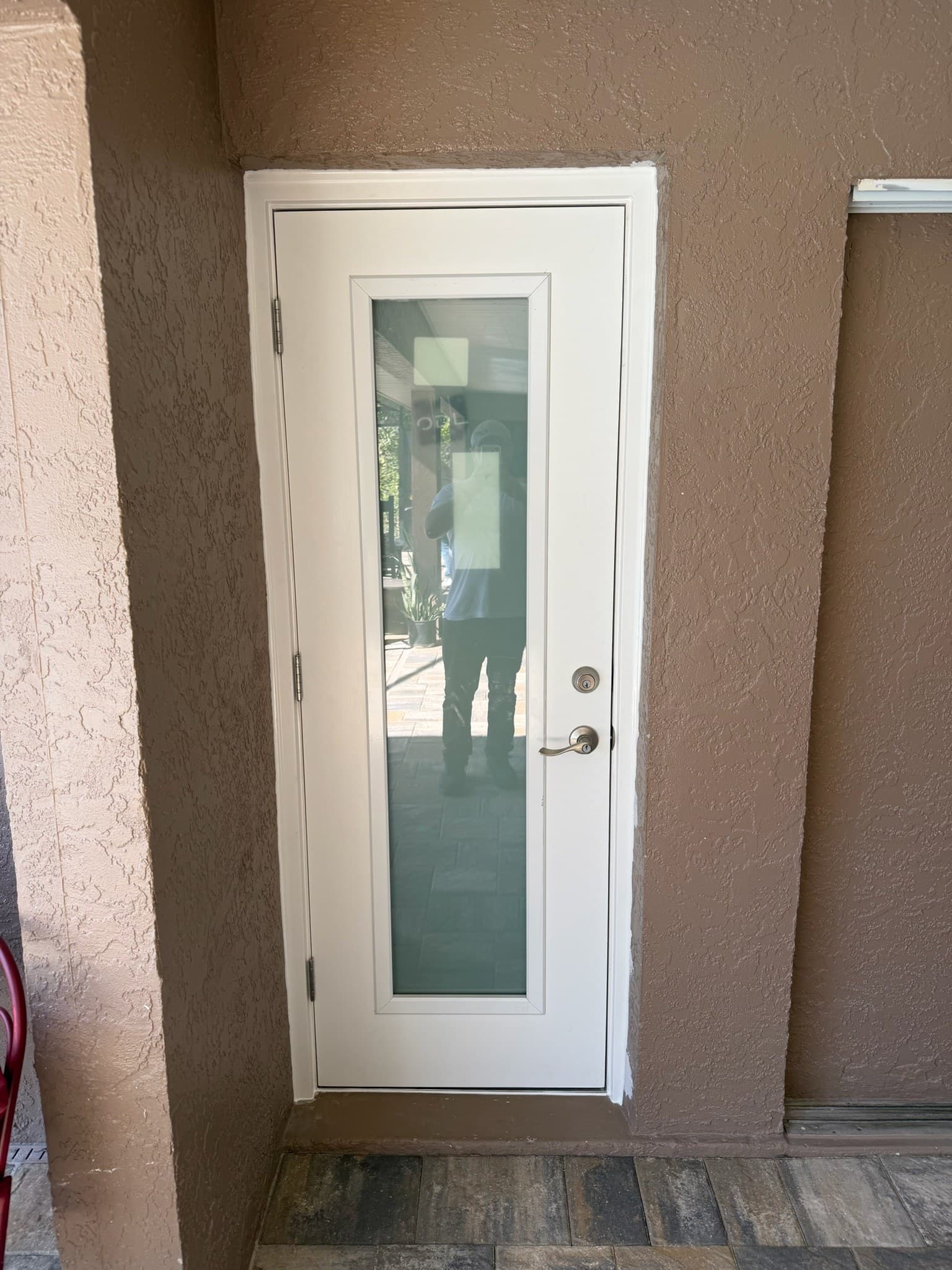
What actually fails, roughly in order
Storm doors take more daily abuse than any other door on the house, opened and slammed by kids, pets, and grocery bags far more than an entry door ever is, and the parts that fail are predictable. In order of how often we see them:
- Pneumatic closers losing tension or starting to slam
- Hold-open washers that no longer catch
- Wind chains, missing, broken, or never installed
- Hinge rails that have sagged or stripped out their screws
- Torn or popped-out screens
- Latch and handle hardware that's worn or loose
None of these require replacing the door. They're individually small, cheap parts, which is a large part of why storm door repair is some of the fastest, lowest-cost work we do.
Pneumatic closers: adjustment before replacement
The closer is the cylinder mounted between the door and the frame that controls how it swings shut. When it stops working, most people assume it's worn out entirely, but there's usually an adjustment step first. At the end of the cylinder, near where the rod connects, there's a small screw that controls closing speed, how fast the door swings through the last few inches before it latches. Turning it one direction slows the door down and cushions the final close; turning it the other way speeds it up. A door that slams hard is very often just that screw set wrong, not a failed closer. What that screw doesn't fix is a closer that's genuinely lost its internal tension, where the door barely pulls itself shut at all no matter how the screw is set. At that point the cylinder is done and gets swapped, which is a quick, inexpensive part. Heavier storm doors often take two closers rather than one, and a door that's sagging on a single closer because the second mounting point was never used is a common, easy fix.
Hold-open washers and the wind chain
The hold-open washer is a small clip on the closer's rod that catches at a set position to prop the door open, useful for carrying things through without the door swinging shut on you. It wears out on its own, independent of the closer itself, and when it does the door simply won't stay propped anymore. It's a small, inexpensive part to replace on its own.
The wind chain is a different piece of hardware entirely, and it gets treated far too casually. It's a short safety chain that limits how far the door can swing open, and its job is to stop a gust of wind from throwing the door past its normal range, which would otherwise rip the closer arm loose or tear the hinges out of the frame. A missing or broken wind chain isn't a cosmetic gap. It's the one piece of hardware standing between a windy day and real damage to the door and the person standing near it, so we treat replacing a broken or missing one as a priority, not an afterthought.
Hinge rails, screens, and latch hardware
Storm door frames are thin extruded aluminum, not solid wood, so when a hinge screw strips out, simply driving a bigger screw in rarely holds for long. The stripped hole usually needs to be filled, with an epoxy filler or a repositioned screw location, before the hinge is reattached properly. A hinge rail that's visibly bent, often from the door being yanked open past its range without a wind chain to stop it, sometimes needs the rail itself replaced rather than just the screws.
Torn screens are among the simplest repairs here. The screen and its spline sit in a removable frame section, and replacing torn mesh is usually a short job on its own. Latch and handle hardware, push buttons, levers, and the strike they engage, wear out with enough cycles like anything else, and given how inexpensive most storm door hardware is, replacing the whole latch unit is usually more practical than trying to repair the mechanism inside an old one.
When a storm door is past worth fixing
There's a point where individual hardware repairs stop making sense. A frame that's visibly bent or racked from a wind event, multiple stripped hinge screw holes on a rail that's already failing, or corners where the frame's welded or crimped joints have separated are all signs the door itself, not just its hardware, has reached the end of its useful life. Storm doors are inexpensive relative to an entry door, and at that point we'll say plainly that a new storm door is the better use of your money rather than stacking repairs on a frame that's already compromised. Short of that, the hardware issues above are worth fixing every time. See the rest of what we handle on the door repair page, or tell us what's wrong and we can often tell you which category your door falls into before we come out.
Frequently asked questions
My storm door slams shut. Is the closer broken?
Not necessarily. Most closers have a small screw at the end of the cylinder that controls closing speed, and a slamming door is often just that screw set too fast. If adjusting it doesn't slow the door down at all, the closer has likely lost its internal tension and needs to be replaced, which is a quick, inexpensive swap.
What does the wind chain on a storm door actually do?
It limits how far the door can swing open, stopping a gust of wind from throwing it past its normal range and tearing the closer arm or hinges loose. It's a safety part, not decorative, so a missing or broken chain is worth replacing promptly rather than leaving off.
Can a torn screen be replaced without replacing the whole door?
Yes. The screen sits in its own removable frame section held in with a spline, and replacing torn mesh is a straightforward, inexpensive repair on its own that doesn't involve the rest of the door.
At what point should a storm door just be replaced instead of repaired?
When the frame itself is bent or racked, when hinge screw holes are stripped out on a rail that's already failing, or when the corner joints have separated. Individual hardware, closers, washers, chains, screens, and latches, are always worth fixing first, since they're inexpensive parts on an otherwise sound door.