
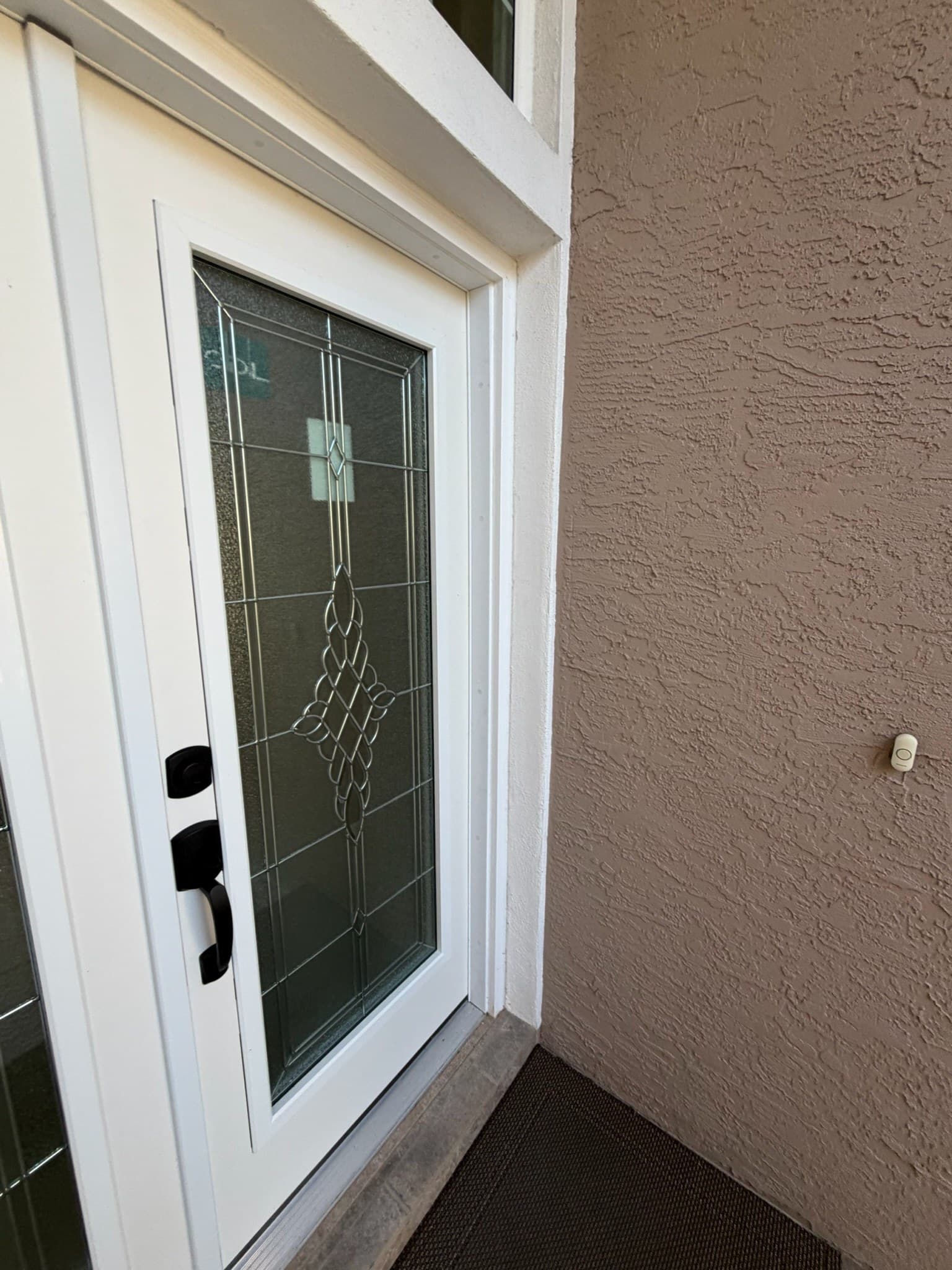
Why one small error becomes an obvious problem on a pair
On a single door, one edge closes against a stop, and a gap of an eighth of an inch along that edge is barely noticeable. On a French pair, the two leaves don't close against a stop at their meeting edge, they close against each other, down the center of the opening where the eye naturally lands. The same eighth-inch of hinge sag that would go unnoticed on a single door shows up as a visible wedge of light, a step where one leaf sits proud of the other, or a gap you can feel with a fingertip right where the two doors are supposed to meet flush. Every source of misalignment that affects a single door, hinge sag, frame settling, a slightly swollen slab, still applies to each leaf of a French pair. The difference is that a pair has nowhere to hide the error, because both edges have to agree with each other, not just with a fixed jamb.
The astragal and the flush bolts on the inactive leaf
Most French pairs have one active leaf, the one used for daily traffic, and one inactive leaf that stays closed most of the time. The inactive leaf's meeting edge usually carries an astragal, a vertical strip that the active leaf closes against, which provides both the seal between the two doors and the surface the active leaf's lock actually engages into. Many French door locksets don't throw into the jamb at all. They throw into the edge of the inactive leaf itself. That leaf is held rigid by flush bolts, usually one at the top and one at the bottom, that extend into strike holes in the head jamb and the sill or threshold. If those bolts don't seat cleanly and fully, the inactive leaf isn't actually rigid, and no amount of adjusting the active leaf's lock will make it engage properly, because the target it's supposed to meet is itself loose.
The order matters: inactive leaf first, then the active leaf to it
We always adjust the inactive leaf first and get it right before touching the active leaf. That means correcting its hinges and shimming until it sits plumb and square in the opening on its own, and confirming the flush bolts engage smoothly into their strikes top and bottom without forcing. Only once that leaf is a fixed, reliable reference do we move to the active leaf, adjusting its hinges so its meeting edge sits evenly against the astragal along the full height of the door and its lock lines up cleanly with the strike in the inactive leaf's edge. Doing this in the other order means adjusting the active leaf against a target that hasn't actually been fixed yet, which turns into a loop of chasing a moving reference instead of solving the actual misalignment.
Hinge shimming across both leaves, not just one hinge
On a single sticking door, one hinge is often the whole problem, and shimming that one hinge solves it. French doors get a more thorough pass, because a slight twist in either leaf shows up as an uneven line along the entire meeting edge rather than a rub at one corner, and a twist can originate at any of the three or four hinges on that leaf. We check and, where needed, shim at every hinge on both doors, adjusting front-to-back position and side-to-side plane until each leaf hangs true on its own before we look at how the two meet each other. It takes longer than a single-door hinge adjustment, but a pair that's only half corrected still shows the error clearly down the middle, which defeats the point of the repair.
Seasonal movement on exterior French doors
Exterior French pairs move with the seasons more noticeably than a single exterior door does, simply because the tolerance at the meeting edge is tighter to begin with. Wood doors expand slightly in humid months and contract in dry, cold ones, and even fiberglass or composite doors shift a little with temperature swings in their frames and hardware. An adjustment that looks perfect in October can show a hairline gap by the following July, not because anything failed, but because the seasonal cycle moved both leaves slightly. This is especially common on older houses, where the surrounding framing itself moves with the seasons on top of the door, something we cover in more depth on our older homes page. A small seasonal recheck is normal and not a sign the first repair was done wrong. For the rest of what we handle on doors, see door repair, and if a pair has settled badly enough that alignment alone won't solve it, repair or replace walks through how we make that call, or reach out and we'll take a look.
Frequently asked questions
Why do French doors go out of alignment more than a single door?
Because the two leaves close against each other rather than against a fixed stop, so any hinge sag or frame movement shows up as a visible gap or step right down the middle where both edges are supposed to meet. The same amount of movement on a single door would barely be noticeable.
Which leaf do you adjust first on a French door pair?
The inactive leaf, the one held by flush bolts at the top and bottom rather than opened daily. It has to be plumb, square, and fully engaged in its strikes first, because the active leaf gets adjusted to meet it. Doing it the other way around means chasing a target that hasn't been fixed yet.
My French door lock doesn't line up even though the doors close fine. What's wrong?
On many French door sets, the lock throws into the edge of the inactive leaf itself rather than into the jamb. If that leaf's flush bolts aren't fully seated, the leaf isn't truly rigid, and the active leaf's lock won't engage properly even if the doors appear to close normally.
Do French doors need to be readjusted every season?
Not usually, but a small recheck from time to time is normal, especially on exterior pairs and older homes where the frame itself moves seasonally. It's not a sign the original repair failed. It's the same wood or frame movement that affects any exterior opening, just more visible on a pair.