
The first few minutes are diagnosis, not adjustment
A door is one rectangle hanging inside another, and there are only so many ways the two can stop agreeing. The first thing we do on a sticking door call is find the exact spot where the slab touches: the burnished stripe where paint has polished off the edge, which part of the gap shuts first when the door swings slowly, and where you have to push. That decides everything after it, from two long screws to an honest conversation about the frame.
Rubbing at the top corner of the latch edge
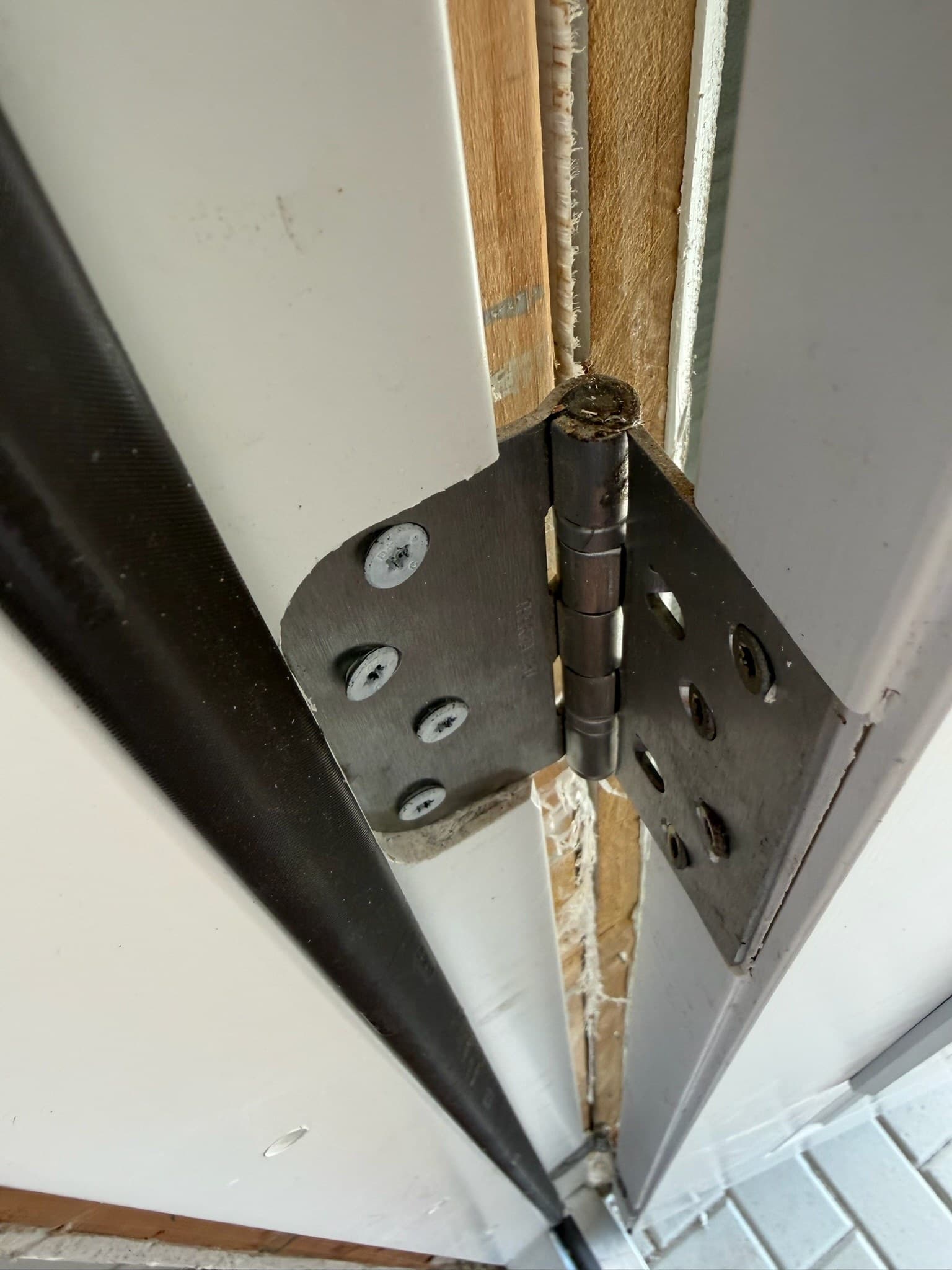
This is the one we see most, and the cheapest to put right. The top hinge carries most of a door's weight every time it swings, and the screws in that leaf are often three quarters of an inch long, biting into nothing but the jamb board. Behind that board is a shim, an air gap, then framing. Years of pulling elongates the holes, the leaf creeps away from the jamb, the top of the door drops toward the latch side, and that corner hits the stop first.
The repair is to swap one or two screws in the top hinge for screws long enough to pass through the jamb, cross the shim space, and land in the trimmer stud behind it. That one change pulls the jamb tight and lifts the latch corner at the same time. We drive them in increments and keep checking the gap all the way around, because a jamb can be pulled too far and bind on the hinge side instead. If the old holes are chewed out, a long screw just spins, so we plug them with glued hardwood and redrill once it sets. Dry toothpicks are a two-month fix, not a repair.
Rubbing along the whole latch edge
When the door drags for the full height of the latch side rather than at one corner, the hinges are usually fine and the opening has moved. Either the house settled and took the frame with it, or the unit was never shimmed properly behind that jamb leg. We pull the interior casing on that side, then reset or add shims until the leg runs straight and parallel to the door edge again. The stop moulding often moves with it, since it was nailed to match the door's old position.
Planing the slab is the last option. When it really is the answer, we prime and paint the bare edge the same day, because an unsealed edge on an exterior door is where the next round of swelling starts.
Dragging on the floor
A door that scuffs the floor has four likely causes, and the shape of the gap underneath says which. An even gap that is simply too tight means the finished floor came up: new carpet, an underlayment, a floating floor over the old one. A wedge that closes toward the latch side is the hinge sag above. A gap that pinches in the middle points at a header deflecting over a wide opening, which is framing work, and we will say so rather than pretend hinge screws fix it. On an entry door, a threshold cranked up on its adjusting screws can imitate all three.
Binding on the hinge side
A door that springs back at you or refuses the last quarter inch is usually hinge bound. Either the mortises were cut too deep when it was hung, or decades of repainting have packed the leaf pockets so the hinge cannot close flat. Shimming behind the leaf with thin stock fixes the first, cleaning paint out of the mortise fixes the second. We also check for screw heads standing proud of the leaf and for a bent knuckle on the middle hinge, common on a heavy door hanging on two good hinges and one tired one.
Doors that only stick in July
Seasonal sticking is a moisture problem, not an alignment problem. Wood takes on humidity fastest through the unsealed end grain at the top and bottom edges, the two faces almost nobody paints. We seal those and leave the fit alone until the door has been through a dry month. Older houses move more than people expect, which is part of why we keep a separate page on windows and doors in older homes.
When we tell you not to bother adjusting it
Three honest cutoffs. A slab warped across its width, so the latch edge no longer sits in the same plane as the hinge edge, will not come flat to the stop no matter what we do at the hinges. A frame racked far enough that straightening it would fight the wall framing is a replacement. And a jamb too soft to hold a screw is a rot repair first. Short of those, adjusting is worth doing before anyone prices a new door. See the rest of what we handle under door repair, or send a photo of the gap and we can usually tell you before we drive out.
Frequently asked questions
My door only sticks in humid weather. Is that worth a service call?
It can be, but the useful work is sealing the door's top and bottom edges rather than cutting anything off. Those two faces are almost never painted, and they are where a slab takes on moisture fastest. Planing a swollen door in August tends to buy you a draft in January.
Can you just plane the door so it stops rubbing?
Sometimes that is the right answer, but it is the last step rather than the first. Material taken off does not come back, and a planed door often needs the strike reset afterward. We check the hinges and the frame first, because one of those is usually the actual cause.
The house has settled. Does the door have to be replaced?
Usually not. Settling moves the frame, and a frame can normally be reshimmed so the door hangs square in it again. Replacement enters the conversation when the opening has racked far enough that straightening the jamb would fight the framing around it, or when the jamb no longer holds a screw.
Will fixing the sticking also fix a deadbolt that will not throw?
Very often, yes. A bolt that misses its strike is usually the same hinge sag showing up at a different point, so lifting the latch corner back into position lines it up again. If it still misses afterward, the strike and the bolt throw get addressed separately.