
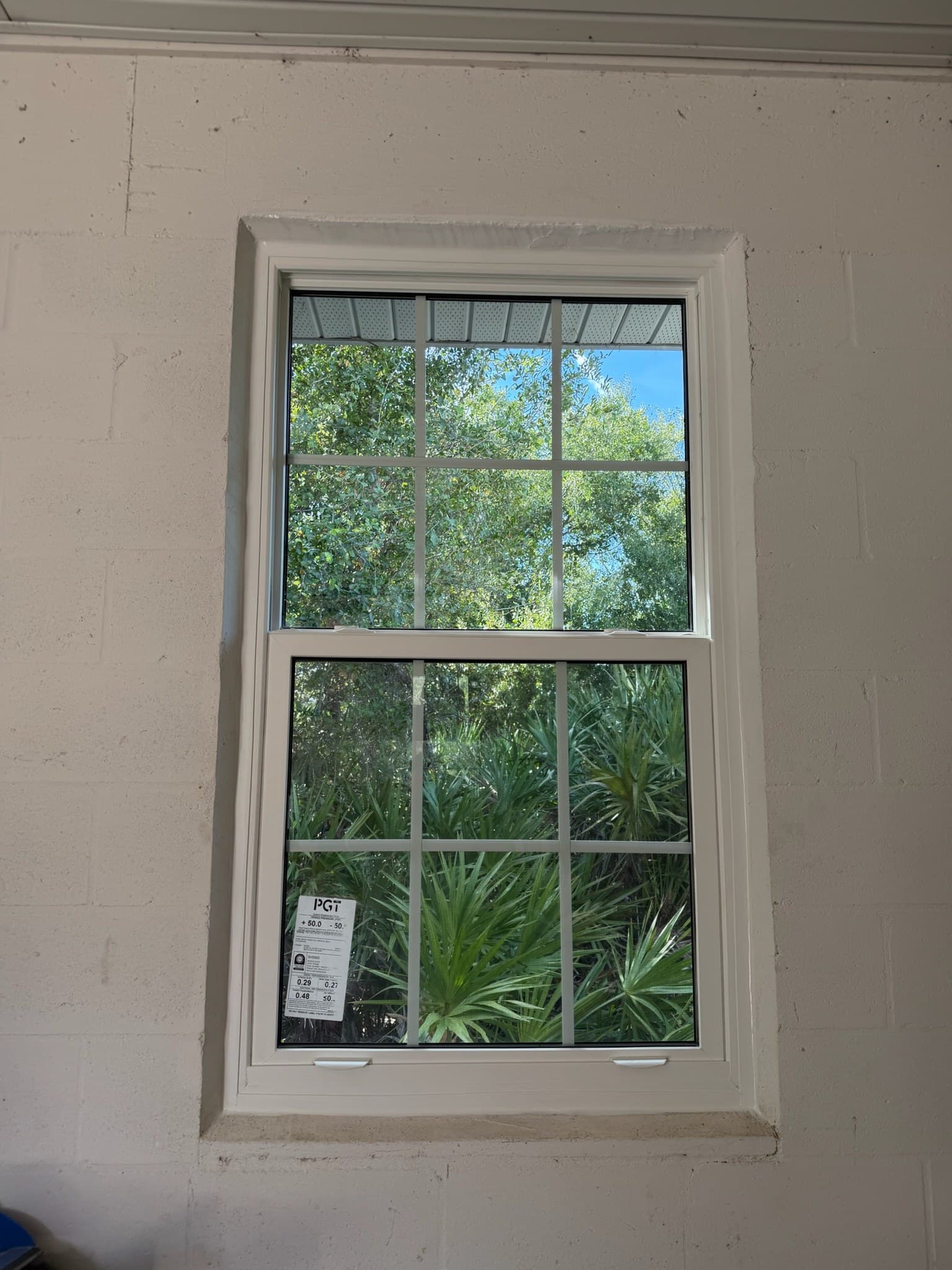
Why a casement seals tighter than a sash that slides
A casement is hinged, not slid. The sash is attached to the frame at two or three points along one edge and swings open on those hinges, pushed and pulled by a crank operator rather than lifted by hand. That single difference, hinged instead of sliding, changes how the seal works and is the real reason a casement tests tighter for air infiltration than a double-hung on the same wall.
A sliding sash has to pass over its own weatherstripping every time it moves, so the seal is built to be wiped past, a soft fin or brush that can never fully compress without binding the sash in its track. A casement sash never touches its weatherstripping until the moment it closes. The seal can be a real compression gasket running the full perimeter, and the multi-point locking hardware, usually a cam handle connected to rods that engage two or three points along the lock edge, pulls the sash into that gasket evenly when you turn the handle. It closes the way a refrigerator door closes, not the way a drawer closes.
Wind direction matters here too. A gust hitting a closed casement pushes the sash further into its seal, not away from it. A gust hitting a double-hung or a slider is pushing along the plane the sash moves in, which is exactly the direction a worn seal or a slightly racked sash lets air through. That's the whole story behind the wind-exposed wall recommendation you'll hear from us and from anyone else who installs both types honestly.
Where a casement earns its keep
Over a kitchen sink or a countertop is the classic case, and for a practical reason that has nothing to do with sealing. A double-hung needs you to reach down and pull a lower sash up or down, which means leaning over the sink or the counter every time. A casement operator mounts low on the sash or the frame and turns with a crank, no reach required, no sash to fight past a faucet or a backsplash.
Casements also open further for a given rough opening than a double-hung does. Because the whole sash swings clear instead of only half the window sliding past the other half, a casement gets closer to the full glass area counting toward net clear opening. On a bedroom or basement job where the rough opening is fixed by what is already in the wall, that difference sometimes decides whether the window meets egress code without enlarging the opening. We cover the code numbers themselves on the egress window page.
And then there's the wall itself. A west-facing gable with open ground in front of it, a corner exposed on a hillside, any elevation that takes sustained wind without anything upwind to break it, is where the compression seal actually shows up on a comfort level you can feel standing near the glass, not just on a lab test sheet.
The crank operator, and what actually wears out
The hardware doing the work is a rotary operator: a small worm gear inside the handle housing that drives a scissor arm or a track arm connected to the sash. Turn the crank, the gear turns, the arm extends or retracts, the sash swings. It's a simple mechanism and a durable one under normal use, and normal use is the operative phrase.
What shortens an operator's life is force. A sash painted shut at the weatherstripping, then cranked hard because it won't budge, bends the arm before the paint bond breaks. A track packed with dirt or old grease that has gone gummy makes the gear work harder than it should every time, which wears the teeth. None of that's a flaw in the window, it's what happens when the hinge side and the weatherstrip never get cleaned or the sash never gets worked through its full travel over a long stretch. The good news is that an operator is a hardware part, replaceable on its own without touching the sash or the glass, which is worth calling about before you assume the whole window is done. More on that distinction on our window repair page.
What a casement doesn't do well
The screen sits on the inside. Because the sash swings outward, the screen has to be behind the glass on the room side rather than outside the frame the way it's on a double-hung, which means reaching past the screen every time you operate the window, and removing it to wash the glass from that side. Some homeowners barely notice. Others find it genuinely annoying, and it's worth seeing one in person before you commit a whole house to the style.
Swing clearance is a real constraint, not a minor one. The sash opens outward a foot or more at full crank, and anything sitting close on the exterior, a deck rail, a shutter, an AC condenser, shrubs that grew up against the house, can stop it short or get hit. On a porch or a walkway, an open casement is something people can walk into, which is worth thinking about before putting one at head height next to a door.
And an open casement catches wind like a sail, because it's a flat panel hinged on one edge with nothing holding the far edge but the operator arm. Left open partway in a gust, it strains the arm and the hinges in a way a sliding sash simply can't, since a slider can't be caught by wind at all when it's open. Closing casements ahead of a storm is a real habit worth having, not just for keeping water out.
Frequently asked questions
Are casement windows more expensive than double-hung?
Generally yes, because of the operator hardware and the multi-point locking system, both of which a double-hung doesn't need. The gap isn't enormous on a single window, but it adds up across a whole house, which is why most houses we work on mix the two rather than going all casement.
Can casement windows have grilles or match a double-hung look?
Yes. Grille patterns and frame colors can be matched across both types, which matters if you're replacing a few windows now and the rest in a later phase. What won't match is the meeting rail look of a double-hung, since a casement is a single uninterrupted sash.
What breaks first on a casement, the hardware or the glass?
The hardware, almost always. The operator arm and the locking cam do mechanical work every time the window opens, while the glass unit just sits there until a seal eventually fails on its own timeline. A stiff crank or a handle that won't fully lock is a hardware problem, not a sign the window needs replacing.
Do casement windows work well for egress?
Often better than a double-hung in the same rough opening, because the full sash clears rather than half of it. Whether a specific unit passes still comes down to the actual clear opening dimensions against the code minimums, which we check before quoting a bedroom or basement replacement rather than assuming a casement automatically solves it.