
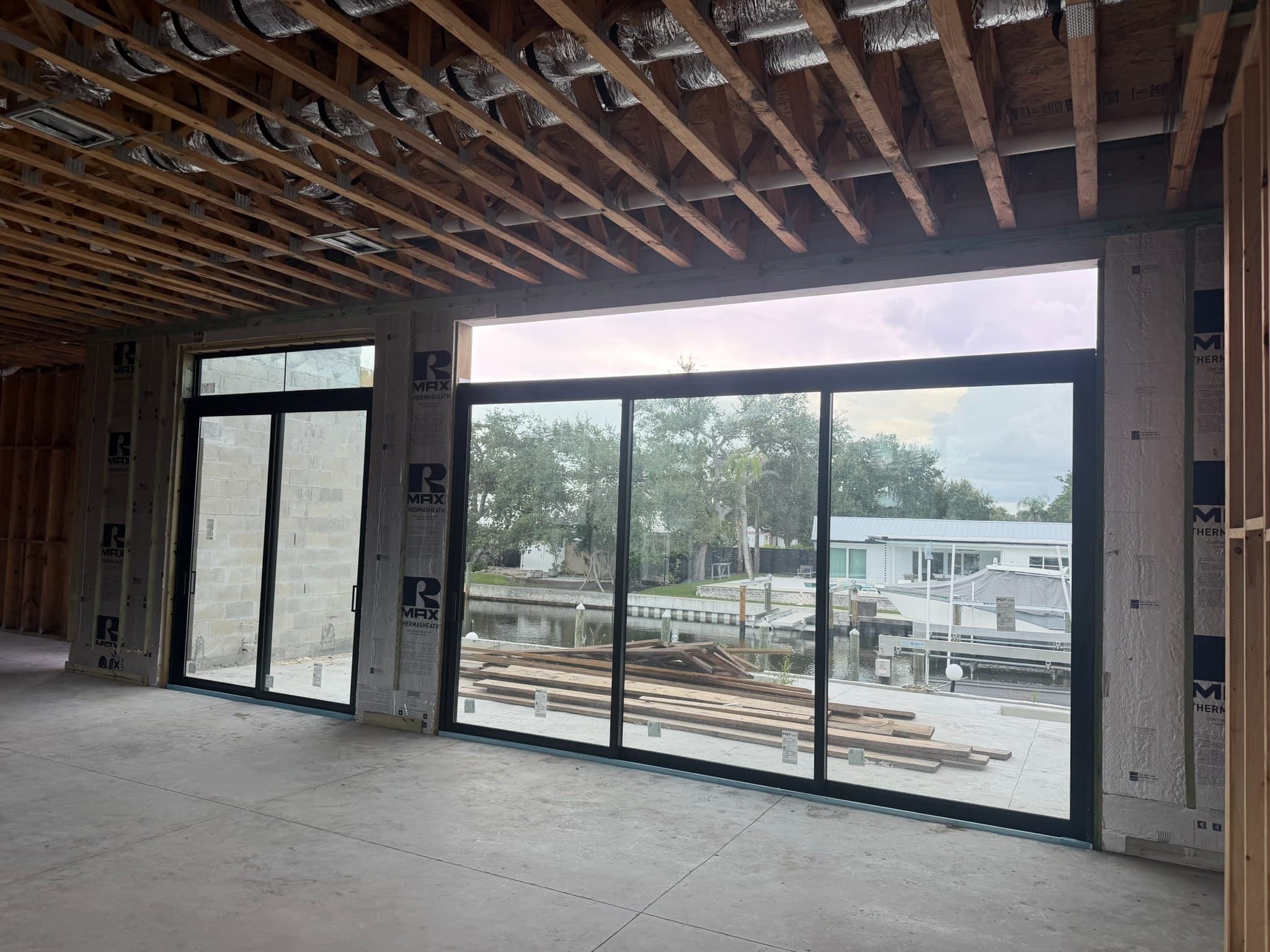
Strength and slim sightlines on big openings
Aluminum is structurally strong relative to how little of it you need. A thin aluminum frame member can carry loads, wind pressure against a large glass panel, the weight of a big sliding door, that would require a noticeably thicker vinyl or wood member to match. On a big opening, a wide sliding glass wall, a large fixed picture unit, anything where minimizing visible frame around a lot of glass is the actual goal, aluminum can hit sightlines the other three materials can't match at the same structural performance. That's the real, legitimate case for aluminum, and it's worth taking seriously rather than dismissing outright.
The thermal bridging problem, explained properly
Aluminum conducts heat extremely well. That's simply a property of the metal, not a manufacturing shortcut, and it means a solid aluminum frame member physically carries interior heat straight to the exterior surface in winter, and carries exterior heat straight in during summer, far faster than vinyl, wood, or fiberglass would. Engineers call a continuous path of highly conductive material connecting warm air to cold air a thermal bridge, and a plain aluminum frame is close to a textbook example of one.
The practical symptom shows up on the frame itself before it shows up anywhere else. In cold weather, the interior surface of an unaddressed aluminum frame gets pulled down close to the outdoor temperature by the metal conducting straight through it, often cold enough to drop below the room's dew point, which is why condensation forming on the interior frame, not just the glass, is such a common complaint with plain aluminum windows in a climate like this one.
What a thermally broken frame actually is
Manufacturers address this with a thermal break: the interior and exterior aluminum sections of the frame are physically separated by a strip of non-conductive material, typically a rigid polymer, so heat has to cross that insulating strip instead of traveling through solid metal from one face to the other. A thermally broken frame performs meaningfully better than a plain one and belongs in any aluminum window being considered for a heated living space in this climate, full stop.
What a thermal break doesn't do is close the gap entirely. A polymer strip a fraction of an inch wide is still a far shorter, more direct heat path than an entire vinyl, wood, or fiberglass frame member, so even a well broken aluminum frame doesn't match the insulating value of those materials. The break narrows the gap. It doesn't close it, and any honest quote for an aluminum window in this climate needs to say that plainly rather than let a thermal break stand in as a full fix.
Where aluminum genuinely wins
Very large openings are the clearest case, big sliding or fixed units where minimizing visible frame really matters to the view and the structural loads involved, a large glass panel's weight, wind load across a big surface, are real. Commercial-style or storefront-style openings on a residential project, sometimes in additions or a more modern renovation where that look is genuinely the goal, are another legitimate case. And some mid-century homes were originally built with aluminum-frame windows as part of their actual architectural character, so a homeowner restoring or maintaining that specific look has a real reason to stay in the same material rather than switching to something that reads differently from the street or changes the proportions the house was designed around.
The honest conclusion for a typical whole-house job
For most residential replacement work in this climate, aluminum is not what we would recommend for a whole house. Vinyl, fiberglass, and wood-clad all outperform it thermally at a comparable or lower cost for standard window sizes, and most houses around here simply don't have openings large enough that aluminum's sightline advantage actually changes anything meaningful. Where it does make sense, the cases above, we'll say so and quote it properly, including a thermal break as a baseline requirement. We aren't going to fill a house with aluminum windows in this climate because the sightlines look good in a photo and then leave the condensation conversation for after the invoice.
Frequently asked questions
Are aluminum windows bad in cold climates?
Plain, non-thermally-broken aluminum performs poorly in a climate like this one, since the frame conducts heat straight through and can develop interior condensation in winter. A thermally broken frame improves that meaningfully but still doesn't match vinyl, fiberglass, or wood-clad on insulating value.
What is a thermal break, and do all aluminum windows have one?
A thermal break is a strip of non-conductive material separating the interior and exterior aluminum sections of the frame, so heat has to cross an insulator instead of solid metal. Not all aluminum windows have one; a plain frame without a break is a poor fit for a heated space in this climate, and it's worth confirming this specifically before buying.
Why would anyone choose aluminum windows for a house here?
Mainly for large openings, wide sliding or fixed units where minimizing visible frame around a lot of glass genuinely matters, or on a mid-century home where aluminum frames were part of the original architecture and the homeowner wants to preserve that specific look.
Is aluminum cheaper than vinyl or fiberglass?
Not usually for a standard residential window once you factor in a proper thermal break, which a cold-climate installation shouldn't be without. On very large custom openings, aluminum's structural efficiency can offset some of that cost, but for a typical house-sized window it isn't the budget option.