
Pennsylvania Dutch Country, not just a name on a sign
Lancaster County has been known as Pennsylvania Dutch Country and the Garden Spot of America for a long time, and both names actually mean something specific here rather than reading as marketing copy. German, Swiss, Welsh, and English settlers started arriving in 1709, and the German and Swiss families among them, Anabaptist communities that grew into today's Amish and Mennonite population, found something about the ground itself worth staying for: limestone-rich soil that turned out to be some of the best farmland on the continent. Three centuries later, the county still has the most productive non-irrigated farmland in the United States, more working farms than any other county in Pennsylvania, and enough dairy production to rank 7th nationally among all U.S. counties. It's also the state's leading producer of cattle, milk, eggs, poultry, and horses. None of that is trivia for a brochure. It's the reason the landscape around every town on our list looks the way it does, and it's a big part of why the Amish and Mennonite communities that trace back to those original German and Swiss settlers are still such a visible, active part of daily life here, not a historical reenactment.
The City of Lancaster itself, the county seat, isn't where we're based or where most of our jobs actually happen. Our work sits out in the townships to the east, East Earl, Blue Ball, New Holland, Terre Hill, Goodville, and Bowmansville, in the working farm country that gives the whole county its reputation, closer to a produce stand than a downtown storefront. That geography shapes the kind of houses we see day to day: fewer rowhomes and denser city blocks, more standalone farmhouses and single-family homes sitting on real acreage, which changes both how a property gets measured and how a crew plans the day, even within one county.
Old stone farmhouses, new construction, same road
Drive any road connecting our towns and you'll see the county's whole architectural history in about ten minutes: an 18th-century limestone farmhouse, walls commonly running close to two feet thick, window openings framed by hand long before anyone standardized a size, sitting a quarter mile from a house built in the last five years to a builder's stock spec. That's not the exception around here, it's closer to the rule.
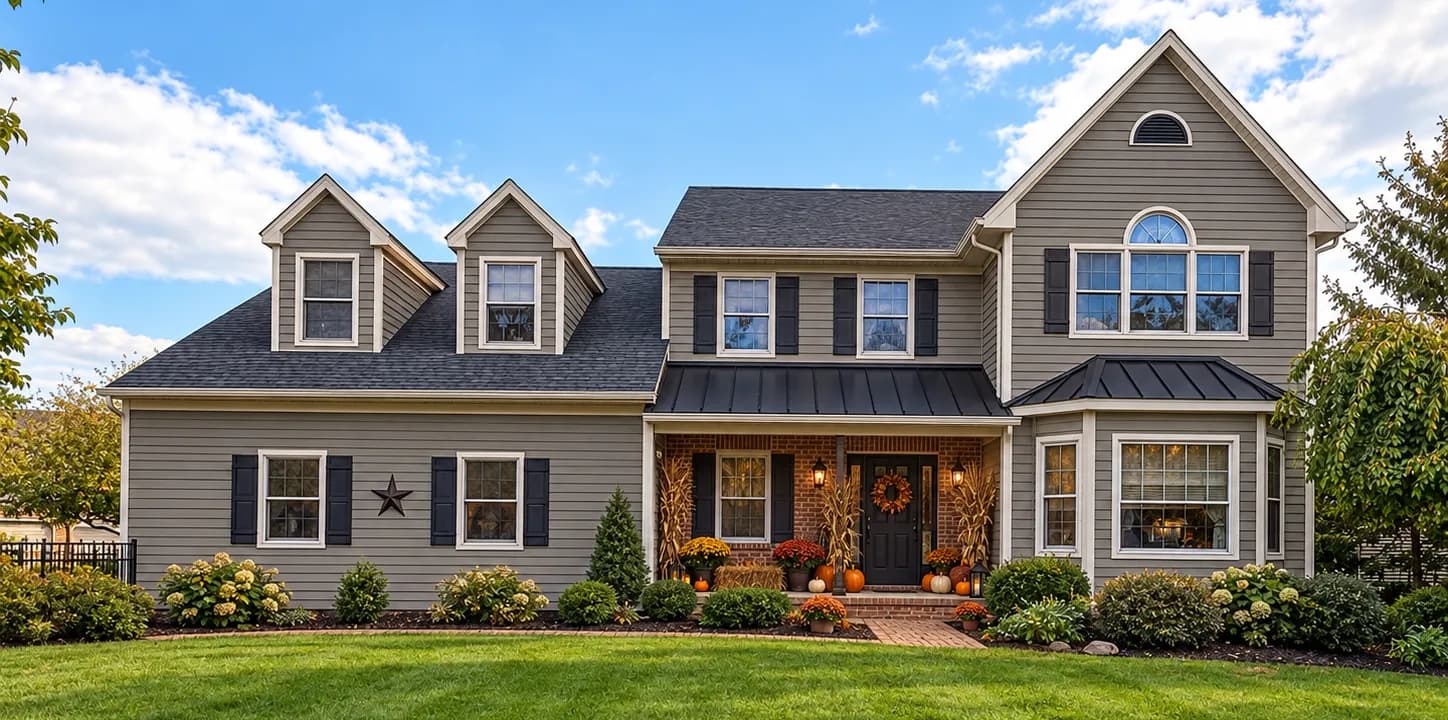
A wall that thick changes more than how a house looks from the road. A window set into two feet of limestone sits deep in a wide reveal, with jambs and a sill that a standard prefabricated trim kit was never built to wrap correctly. Getting a replacement window to actually sit right in an opening like that, not just fit through the hole but read correctly in the wall, takes different jamb extensions and different trim work than the same job on a stick-built house from last decade, where the wall might be a third as thick and built from the start to receive a stock unit with stock trim, no adjustment needed. Same county, sometimes the same road, two completely different jobs.
Farms across the county followed a broadly similar pattern when they were originally built: a limestone or fieldstone farmhouse for the family, plus a run of outbuildings, often including a bank barn built into a slope so wagons could load hay directly into the upper level. Those outbuildings aren't usually what brings us out to a property, but they're part of why a lot of these farms have more window and door openings spread across more structures than a typical suburban lot: a farmhouse, a summer kitchen, sometimes a converted outbuilding that has since become living space, each with its own era of construction and its own set of openings to account for.
That contrast is exactly what drives the range of work we do across East Earl, Blue Ball, New Holland, Terre Hill, Goodville, and Bowmansville. Some calls need a custom-sized unit measured to a two-hundred-year-old opening. Others need a straightforward swap of a builder-grade window or door that was never meant to last more than a couple of decades in the first place. We walk through the difference between those two situations in more detail on our repair or replace page and our guide to older homes, because guessing which one you've got from a phone call alone isn't something we're willing to do.
None of this is a reason to expect a complicated process, it's a reason we don't quote sight unseen. A single property in East Earl or Blue Ball might genuinely need three custom-sized units and two stock ones on the same job, and the only way to know which opening falls into which category is to walk the property and measure by hand, not estimate from a description over the phone. We'd rather spend the extra twenty minutes on a site visit than hand someone a number that changes the day the crew shows up, because on a road where a 1780s farmhouse and a 2020 build can share a mailbox, a one-size quote isn't an honest one.
Farmland towns and Main Street towns, side by side
Even within the six communities closest to our shop, this part of Lancaster County doesn't have one single character, it has at least two, sitting a few minutes apart from each other. East Earl, Blue Ball, and Goodville are all genuinely rural: unincorporated communities inside East Earl Township, built around crossroads rather than a platted downtown, surrounded by working farmland and dominated by farmhouse-scale construction from the 18th and 19th centuries sitting next to newer single-family homes. None of the three has its own borough council. Zoning and permitting questions for any of them go through the same township office.
New Holland and Terre Hill are a different story. Both are incorporated boroughs, New Holland since 1895 and Terre Hill since 1907, and both grew up around an actual local economy rather than purely around farming: New Holland as a rail and farm-equipment hub that's now home to a company known worldwide, Terre Hill as a center of 19th-century cigar manufacturing. That history shows up physically. Instead of farmhouses spaced along country roads, both towns have a walkable core of turn-of-the-century construction, buildings built close together on real street grids, with their own borough governments and their own exterior-work rules to check before a project starts.
Bowmansville doesn't fit cleanly into either category. It's rural like the farmland trio, farmhouse-scale construction on real acreage rather than a dense borough block, but it isn't inside East Earl Township at all, it sits directly on the line between Lancaster and Berks counties. That puts it in a category of its own: genuinely rural, but administratively split between two counties instead of contained inside one township the way East Earl, Blue Ball, and Goodville are.
That range, three rural villages inside one township, two historic boroughs with their own local governments, and one county-line community that belongs fully to neither side, is part of why we don't run one standard estimate across the whole service area. A job in a New Holland rowhome and a job on a Bowmansville farmhouse start from two different building types, two different sets of local rules, and often two different eras of construction, even though both are well under fifteen minutes from our shop.
The county's Amish and Mennonite population is also part of daily scheduling in a way it wouldn't be in most other parts of Pennsylvania. Not every property we visit has a phone number or an email address on file, and we've learned to work around that rather than treat it as an inconvenience, coordinating visits and follow-ups in whatever way actually works for a given household. It's a small operational detail, but it's a real one, and it's part of why a company that's only ever worked outside Pennsylvania Dutch Country can end up flat-footed on something as simple as confirming an appointment.
Frequently asked questions
Are Lancaster County's Amish and Mennonite communities part of your service area?
Yes. A lot of our customers across East Earl, Blue Ball, New Holland, Goodville, and the surrounding townships are Amish or Mennonite families, and we work with the same care and the same on-site measuring for every property regardless of who owns it. If a property doesn't have phone or email on file, we're used to scheduling around that.
Can original windows in an 18th- or 19th-century farmhouse actually be replaced, or do they need custom sizing?
Usually custom sizing, or at least a careful decision about it. Openings in a limestone farmhouse built before standardized lumber were framed by hand, so a stock-size replacement window often doesn't fit without extra trim work. We measure every opening on site before quoting rather than guessing from a phone call, and we'll tell you honestly if repair makes more sense than replacement.
How fast can you respond to a job farther out in the county, not just near East Earl?
Every town in our closest group, East Earl, Blue Ball, New Holland, Terre Hill, Goodville, and Bowmansville, is under ten minutes from our shop, so response time there is basically same-day. Farther corners of the county still fall within our service area, we're just upfront if a longer drive changes scheduling.
Do East Earl, Blue Ball, and Goodville have different building rules than New Holland or Terre Hill?
Potentially, yes. New Holland and Terre Hill are incorporated boroughs with their own local governments and zoning authority, while East Earl, Blue Ball, and Goodville are unincorporated communities inside East Earl Township. We'd rather a homeowner check with the right office before committing to a product than assume the same rules apply everywhere.